

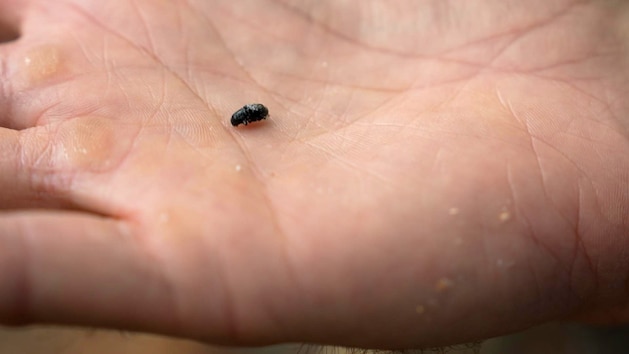
To walk deep into the mountain forests at the doorstep of the Rocky Mountains, is to encounter the fragrant majesty of century-old ponderosa pine trees famous for lining ski slopes, National Park trails and residential neighborhoods.
Now, those iconic Colorado trees — already under strain from record heat and prolonged drought — are threatened by a rapidly growing outbreak of silent killers: the mountain pine beetle.
The size of a grain of rice, the native forest insect can attack a tree in a matter of weeks, feeding upon its critical tissues and effectively strangling it from within.
“Once a tree has been attacked, it’s likely to die,” said Sarah Hart, a forest ecologist with Colorado State University. “For managing large landscapes, we really don’t have particularly effective strategies to stop it.”
WATCH: Outbreak: Hidden Costs of the Climate Crisis at 7 and 9 p.m. ET Monday on ABC News Live PRIME, streaming on Hulu, Disney+ and ABC News apps.
More than 700,000 acres in Colorado are affected, officials say. Climate change is blamed for supercharging the emerging outbreak, with no end in sight.
Some state officials have called them “zombie forests”: ponderosa that appear to be healthy but are under existential threats from a changing climate that may result in extinction in some areas.
“We’ve had this dearth of precipitation, above-average temperatures — It’s kind of like attacking the bank when there’s no security guard,” said Dan West, an entomologist with the Colorado State Forest Service. “These trees are standing there with not a lot of defenses.”
The cost of responding to the pine beetle outbreak, along with the financial impacts from other climate-change influenced environmental threats, are at the heart of a major Supreme Court case being argued Monday in Washington.
The City of Boulder and Boulder County, Colorado, in 2018 sued major fossil-fuel producers Exxon Mobil and Suncor Energy, seeking financial damages under state public nuisance law.
Their complaint alleges the companies “knowingly caused and contributed” to climate change by promoting fossil fuels “while concealing and/or misrepresenting the dangers,” including “devastation” to forests from an “epidemic” of mountain pine beetles.
Exxon and Suncor, which declined interviews for this story, argue in court papers that the Boulder lawsuit is based on a “dubious theory,” insisting local harms from the global phenomenon of climate change cannot be pinned on individual companies.
They’re asking the U.S. Supreme Court to toss the case out.
“National issues should be decided at the national stage, and that means Congress needs to be the one to decide what are the rules for who pays, who ultimately pays, what are standards for imposing those costs,” said Michael Williams, solicitor general of West Virginia, which has joined 25 other states backing Exxon and Suncor.
“If these suits go forward, higher gas prices are maybe the smallest consequence. I think it’s even bigger than that and you’re going to see some of these industries potentially shutter entirely,” Williams said.
Boulder city and county officials declined interview requests about the case.
Longtime Boulder resident Paul Chinowsky, a civil engineer specializing in climate impacts, said he doesn’t want the oil companies to go bankrupt but agrees they should chip in for alleged harms from their product.
“Let’s be real. We can’t live today without some level of fossil fuels, but we need regulation,” Chinowsky said in an interview in his neighborhood on the outskirts of Boulder.
“We see streets getting resurfaced. We see drainage systems getting updated, and we think of it all as, well, this is just a part of regular maintenance. Climate change is putting an accelerator on that,” he said.
Boulder and Boulder County say in court documents that they’ve spent millions on road repairs, storm drainage improvements and utility upgrades to keep pace with other environmental threats amplified by climate change.
“It’s become a significant element of the city’s budget,” said John Tayer, CEO of the Boulder Chamber of Commerce. “There are direct costs associated with the change in climate. Just everything from rising heat, which leads to greater air conditioning costs. It can slow down outdoor work because of the risk to the workforce from heat exposure. It’s across the board.”
Then there is the mountain pine beetle.
Driving from Boulder along Interstate 70 into the Front Range, rust-colored clusters of dead ponderosa pine streak the mountainsides. From above, the scale of the crisis is even more dramatic.
Bark beetles killed more than 54 million acres of pines across the West in the early 2000s, an area the size of the state of Utah. The new outbreak is expected to be much worse for communities in fire-prone areas.
“We’ve seen a lot of sporadic wildfire activity when you have a lot of dead trees like this,” said Dan Gibbs, a veteran wildland firefighter who heads Colorado’s Department of Natural Resources, “Bark beetle-kill timber burns differently than I would say a green, alive forest.”
Teams of state foresters are scrambling to clear beetle-killed trees from hillsides near residential communities to reduce fuels for fire, one dead tree at a time. The cost to state taxpayers: $10,000 per acre, Gibbs said.
“Fire hazard, impacts to recreation, impacts to watersheds — the [dead trees have] a huge ripple effect on almost daily life of Coloradans and visitors,” he said.
If the nation’s highest court allows Boulder to sue Exxon and Suncor for damages, it won’t halt a pine beetle outbreak that state officials say will last from years to decades. But supporters of the case hope it brings increased accountability — and more funding to protect Colorado’s ponderosa pines and the people who love them.
“Oftentimes the people and the organisms that are facing the most dramatic impacts of climate change are not the ones who are benefiting from what’s causing climate change,” said Hart. “I do think that there should be greater accountability for those negative effects.”
Copyright © 2026, ABC Audio. All rights reserved.
