

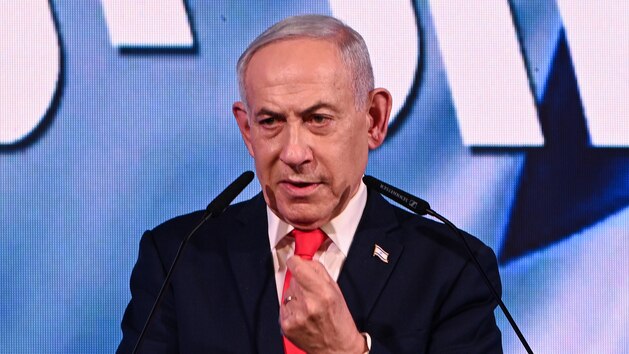
President Donald Trump on Tuesday said he made a deal with Israeli Prime Minister Benjamin Netanyahu that will see the U.S. “cut off” military aid to Israel this year because Republicans “suffer the slings” from Democratic candidates over the issue.
The president’s comments came as voters head to the polls for the last day of voting in the high-stakes midterm elections. The elections could ultimately determine how effective Trump’s agenda is in the back half of his second term.
Watch ABC beginning at 7 p.m. EST for live Election Night 2026 coverage and results. Also streaming on Disney+ and Hulu.
“Bibi Netanyahu and I have made a deal that — we give Israel $4 billion a year — and we made a deal months ago that we’re stopping, and … they’re fine with it because, you know, they’ve become a very successful country. They don’t need it, and we won’t be paying any more,” the president said in an interview on Fox News. “So it’s just a wasted thing because we’ve already agreed that by the end of this year, we won’t be paying Israel.”
Trump did not provide specifics on the forms of military aid that will end, nor how it will be ended.
Trump made the comment after he was asked about the rise of antisemitism, that it appears “the next generation has no interest in providing arms, selling arms to Israel” and that Michigan Democratic Senate candidate Abdul El-Sayed is counting on the shift in public opinion regarding U.S. military aid to Israel in his election bid.
El-Sayed, who is in a tight race with Republican former Rep. Mike Rogers, has said of Israel that if elected, his responsibility would be Michigan’s children “rather than thinking about what’s in the interest of a foreign government.” He has rejected antisemitism charges during the race.
An ABC News/Washington Post/IPSOS poll last month found 58% of Americans say the U.S. should either reduce military support to Israel or end it completely.
The president said politics influenced the decision to cut aid because he doesn’t want to give Democrats a “talking point” to use against Republicans.
“We were giving them $4 billion. We are, but it gets cut off at the end of the year,” Trump said.
“Why?” Fox’s Brian Kilmeade pressed the president.
“Because they don’t need it, Brian. I mean, I ask them because they don’t need it, and because why should we suffer the slings from lunatics like an El-Sayed when they don’t need it?” Trump said. “It’s a bad — it’s a bad talking point because you say, ‘Why don’t we give everybody $4 billion?’ Israel’s our number one. We give them more than anybody else, and they no longer need it.”
Trump added that Netanyahu “brought it up” and that it would be “appropriate” to end aid.
Netanyahu has not yet released a public statement on Trump’s comments. Neither the prime minister’s office nor the Israeli Defense Ministry immediately responded to ABC News’ requests for comment.
Trump, when pressed, did not specify if the move meant was the U.S no longer giving military equipment or money, but suggested it was part of an effort to balance the federal budget.
The vast majority of U.S. military aid to Israel is governed by a 10-year memorandum of understanding between the countries. The current agreement, which was negotiated and signed toward the end of the Obama administration, is set to expire at the end of fiscal year 2028.
Two sources at Israel’s Finance Ministry, who requested anonymity because they weren’t authorized to speak on the record, expressed surprise at Trump’s comments, with one highlighting the Obama-era MoU and the other noting that the future annual budget had already been drafted based on the current agreement.
Under the current MoU, the U.S. provides Israel with $3.8 billion in support annually. Much of that — $3.3 billion — is Foreign Military Financing (FMF) — which is money primarily designated for the purchase of U.S.-manufactured defense equipment. Per the terms of the deal, Israel is required to spend 92% of its FMF on U.S.-made defense products in 2026 and 2027, and 100% of it on American goods in 2028.
MoUs are not legally binding agreements, but Congress effectively codified the annual FMF support levels stipulated by the current deal with Israel as part of the National Defense Authorization Act for Fiscal Year 2021 — a measure that had bipartisan support at the time it was passed into law.
Netanyahu has publicly called for the phasing out of U.S. military aid for Israel, arguing that the country doesn’t need the assistance anymore and expressing a preference for joint investments instead. It is unclear if he would support an abrupt cancellation of the current MoU.
Gadi Eisenkot, Netanyahu’s main rival in last week’s Israeli election, responded to Trump’s announcement in a statement on Tuesday evening local time, saying that his country’s “special relationship with the United States is a key component in its national security.”
“The fact that the security establishment, along with Israeli citizens, is learning about a change in the strategic relationship framework through the media highlights just how much Benjamin Netanyahu’s conduct poses a genuine danger,” he said. “We can no longer rely on him and must replace him.”
Eisenkot said Netanyahu “must provide answers to Israeli citizens” immediately.
The final vote count from last Tuesday’s parliamentary election showed that Netanyahu’s bloc maintained its lead, securing 53 seats in the next Knesset, but no coalition secured a 61-seat majority.
The opposition bloc led by Eisenkot won 48 seats, according to official Central Elections Committee figures released on Thursday after all votes had been counted.
Copyright © 2026, ABC Audio. All rights reserved.
