

(WASHINGTON) A United States ban of hundreds of millions of dollars worth of Canadian products took effect on Tuesday, escalating a trade war between the longtime allies and pinching imports from one of the top U.S. trade partners.
The ban applies to an array of products spanning from alcohol to motorcycles to dairy goods, White House documents show.
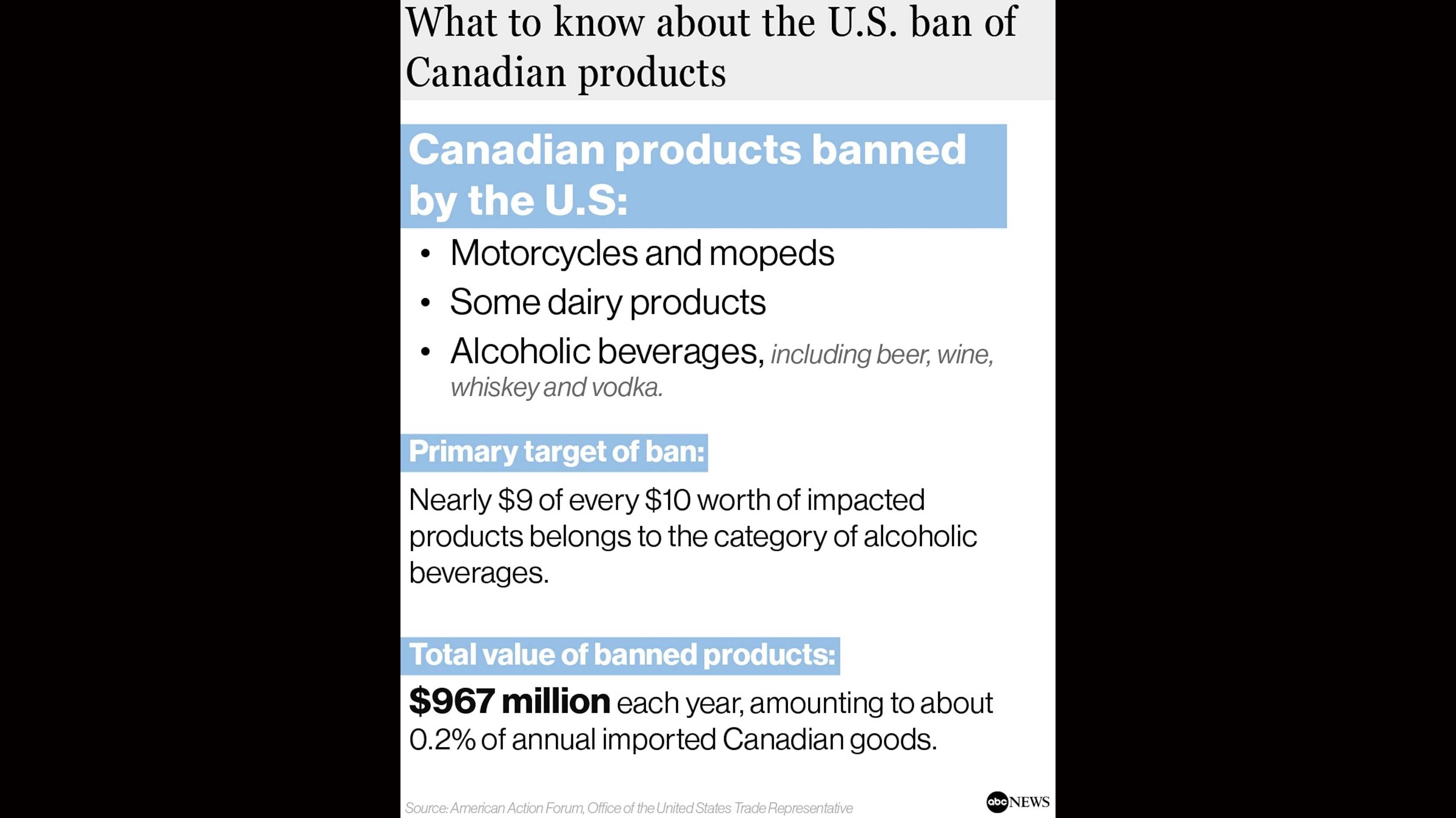
In all, the affected products account for $967 million worth of annual imports from Canada, Jacob Jensen, director of trade policy at the right-leaning American Action Forum, said in a blog post.
Nearly $9 of every $10 worth of impacted products belongs to the category of alcoholic beverages, making them the primary target of the ban, Jensen said. The move comes after some Canadian provinces pulled U.S.-made alcohol off of liquor store shelves, crimping sales for American producers.
The list of banned alcoholic products includes beer, wine, whiskey, vodka, rum and brandy.
The policy also bars some mopeds and motorcycles, as well as some food items featuring whey, a popular protein-rich additive derived from dairy. Molasses and non-alcoholic beer also stand among the banned imports.
Still, the U.S. ban applies to a small fraction of U.S. imports from Canada. The U.S. imported roughly $381 billion worth of goods in 2025, the Office of the United States Trade Representative found, meaning the ban covers 0.2% of Canadian products shipped to the U.S.
The Toasts Not Tariffs Coalition — a trade group representing farmers, retailers and other members of the U.S. alcohol supply chain — issued a statement on Tuesday criticizing the ban.
“We appreciate the Trump administration’s commitment to encouraging Canada to reopen its market to American spirits and wine products,” the organization told ABC News.
“However, as this ban on Canadian spirits and wines takes effect today, America’s restaurants, bars, retailers and consumers are being pulled further into a trade dispute that has already taken a significant toll on U.S. wine and spirits producers,” the group added.
A tit-for-tat trade war erupted in August after official negotiations collapsed and a fresh round of U.S. levies took hold. Within days, Canadian officials unveiled what they described as a set of matching tariffs.
Canada’s retaliatory measure, which took effect earlier this month, targets about $20 billion worth of U.S. products, mirroring the size of the U.S. levies.
The goods impacted by both countries’ levies total about 4.5% of annual trade between the U.S. and Canada, the Office of the United States Trade Representative said. For now, levies apply to a sliver of goods that travel between the U.S. and Canada, limiting the impact of the trade dispute.
Trump has carried out on-again, off-again trade negotiations with Canada since he took office, aiming to resolve a dispute that began with tariffs announced by Trump early in his second term.
Trump has repeatedly claimed Canada takes advantage of its proximity to the large U.S. consumer market, while preventing many U.S. sellers from reaching Canadian shoppers.
“On Trade, and in other ways, also, they are among the worst Nations in the World to deal with,” Trump said on his social media platform in August. “They feel entitled, and yet, WE DON’T NEED CANADA, THEY NEED US!”
Canadian Prime Minister Mark Carney has criticized fresh U.S. tariffs as a pressure campaign that disadvantages Canadian exporters, describing retaliatory levies as an effort to protect Canada’s economy.
“I don’t believe in escalating the conflict. That’s not constructive, but our tariffs are necessary to protect our workers, protect our companies and our communities. We can’t let American goods into Canada tariff-free while they charge our companies to export,” Carney said in a video message posted earlier this month.
Copyright © 2026, ABC Audio. All rights reserved.
