

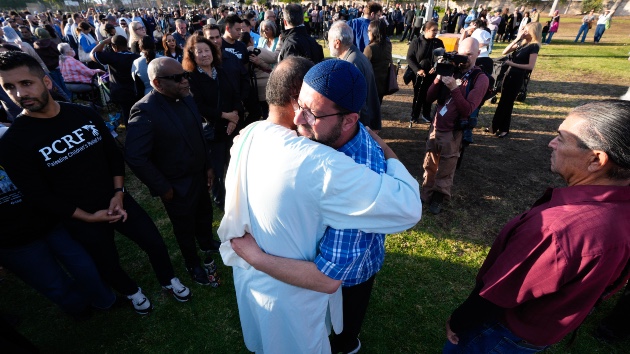
(SAN DIEGO) — Investigators are continuing to build a picture of the two suspects in the deadly Monday shooting at the Islamic Center of San Diego which killed three people, and which law enforcement officials say may have been driven by nihilistic and accelerationist extremism.
Three men, one of whom was a security guard, were killed in the shooting on Monday, authorities said, with investigators saying they are currently considering the incident as a hate crime.
Two suspects, aged 17 and 18, were found dead in a vehicle nearby, police said. Authorities are investigating two teenagers, Cain Clark and Caleb Vazquez, as the suspected attackers in the shooting, several sources told ABC News.
Authorities are reviewing a video apparently posted online by one of the suspects in Monday’s shooting that appeared to capture a livestream of the attack and its aftermath, sources told ABC News.
Sources said a video posted to an online gore site allegedly shows the suspects approaching the center and then opening fire, with a person believed to be suspect Clark wearing camouflage fatigues and a plate carrier.
In a later portion of the video, sources said the person believed to be Clark can be seen reaching into the backseat of the vehicle and then shooting Vazquez, before chambering a second round and taking his own life.
The video and items found with the suspects’ bodies appeared to indicate associations with extremist ideology, law enforcement officials said.
A Sonnenrad patch, depicting a neo-Nazi symbol, and what analysts assess is likely a patch for a militant accelerationist group, are both visible on the plate carrier being worn by the person believed to be Clark, according to sources. Additionally, writings are visible on a gun, including drawings of SS bolts and neo-Nazi insignias, sources said.
Further symbols associated with neo-Nazism and militant accelerationism were found at the scene of the shooting, including a flag with a Sonnenrad on it and a gas can with SS bolts drawn on it, according to sources.
Investigators are examining a lengthy document circulating online that is comprised of two hate-filled essays totaling 75 pages allegedly written by the suspected shooters, sources told ABC News.
Both essays promote white nationalism and express a hatred for immigrants, racial minorities and others, as well as anger toward women who prefer taller men, according to sources. Vazquez allegedly writes he is an “accelerationist” in his essay, echoing nihilistic rhetoric, sources said.
It’s unclear when the essays were actually written — a section intended to identify the “targets” is left blank, sources said.
Social media accounts believed to be tied to Clark reflect possible associations with nihilistic violent extremist ideology, sources also told ABC News.
Early last year, police in Chula Vista, California, spoke with Vazquez after someone who knew him expressed concerns that he was interested in extremist ideology and mass-casualty attacks, though the concerns at that point didn’t meet the threshold for making an arrest, sources told ABC News.
A spokesperson for the Chula Vista Police Department told ABC News on Tuesday that the department “extends its deepest condolences to all those affected by this tragedy” but declined to answer questions about the prior contact.
The suspects met online and discovered they both lived in the San Diego area, according to Mark Remily, the special agent in charge of the FBI’s San Diego Field Office. They appear to have been radicalized online and had a “broad hatred” toward a wide array of races and religions, Remily said during a press briefing Tuesday.
“They didn’t discriminate on who they hated,” Remily said.
Investigators have recovered writings that outline “religious and racial beliefs of how the world they envision should look,” Remily said. Authorities are in the process of analyzing their writings to learn what led to the attack and how to prevent future ones, as well as looking into “how the radicalization occurred,” he said.
It’s too early in the investigation to tell if the mosque was the specific target, authorities said.
“We’re still looking through electronics to give us the answers, but again, what I can say is they definitely had a broad hatred towards a lot of folks,” Remily said.
San Diego Police Chief Scott Wahl said law enforcement is still working to determine the scope of the “threat picture,” when asked if the Islamic center’s schools were the intended target.
Police are investigating how the suspects obtained firearms in the shooting, Wahl said Tuesday. The guns belonged to the parents of one of the suspects, he said.
During searches of two residences associated with the suspects, authorities seized “numerous pistols, rifles, shotguns, ammunition, tactical gear, as well as electronics,” Remily said.
“So far in this investigation, we’ve seized over 30 guns and a crossbow,” he said.
The shooting was reported shortly before noon Monday, police said.
A video review shows that the suspects got into a “gun battle” with the security guard, who was killed outside the mosque, according to Wahl.
The security guard had managed to put out a “lockdown protocol,” which along with the sound of gunfire, allowed those in the main common areas of the mosque to go into hiding, he said. There were some 140 children inside at the time, he said.
The suspects moved room by room once inside, but did not run into anyone, the police chief said. At one point, they are seen looking out a window, with one pointing to the window, before running out a nearby door, at which point they “immediately engage” the two other victims outside in the parking lot, he said.
Amin Abdullah, the security guard killed, has been hailed as a hero.
“His actions, without a doubt, delayed, distracted and ultimately deterred these two individuals from gaining access to the greater areas of the mosque where as many as 140 kids were within 15 feet of these suspects,” Wahl said Tuesday.
The two other victims killed in the shooting — identified by authorities as Mansour Kaziha and Nadir Awad — “drew the attention” of the suspects into a parking lot “where they were unfortunately unable to flee,” Wahl said. They were cornered by the suspects and killed, Wahl said.
Police are investigating a potential motive but said the shooting is currently being considered as a hate crime.
“There was definitely hate rhetoric that was involved,” Wahl said during a Monday press briefing.
Anti-Islamic writings were found in the vehicle with the two teens, sources told ABC News.
About two hours before the shooting at the mosque, San Diego police received a call involving the 17-year-old suspect, about a runaway juvenile, according to Wahl. The teen’s mother reported that “several of her weapons” and her vehicle were missing, he said. The mother also found a note, Wahl said, the contents of which the police chief did not share.
The mother told police that her son was with another individual and that they were both “dressed in camo,” Wahl said.
Officers were attempting to track down the vehicle and dispatched police to a mall and to a school with which one of the teens was associated, when the shooting at the mosque was reported, he said.
The Islamic Center of San Diego says it is the largest mosque in San Diego County.
“We have never experienced a tragedy like this before,” Taha Hassan, Imam and Director of Islamic Center of San Diego, said of the center at a news conference.
“It is extremely outrageous to target a place of worship. Our Islamic center is a place of worship. People come to the Islamic center to pray, to celebrate, to learn, not only Muslims, but we have people from all walks of life,” Hassan added.
“The religious intolerance and the hate, unfortunately, that exists in our nation is unprecedented,” Hassan said.
“We strongly condemn this horrifying act of violence,” Tazheen Nizam, the executive director of the San Diego chapter of the Council on American-Islamic Relations, said in a statement. “Our thoughts are with everyone impacted by this attack. No one should ever fear for their safety while attending prayers or studying at an elementary school.”
San Diego Mayor Todd Gloria told ABC News that “we immediately have increased patrols around religious sites, both our Muslim, Jewish and other faith communities across the city. And I imagine we’ll maintain that posture for some time.”
Copyright © 2026, ABC Audio. All rights reserved.
