

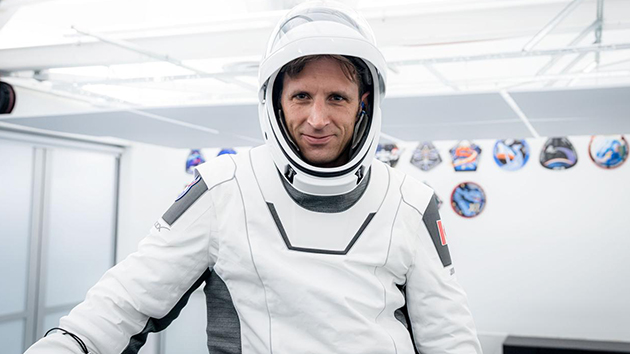
When Canadian Space Agency astronaut Joshua Kutryk climbs aboard the SpaceX Dragon spacecraft atop the Falcon 9 rocket that will take him and the other three members of NASA’s SpaceX Crew-13 to the International Space Station, he’ll bring a more than 100-year-old pocket watch.
Kutryk, a fourth-generation Ukrainian Canadian, says he’s bringing the timepiece because “I need a watch to tell time,” but also because it’s been a family heirloom since the first generation that reminds him of how far his family and the world have come.
“For me, it’s really neat to look at that and reflect on just how much has changed in those 100 years, a little over 100 years,” said Kutryk during a prelaunch news conference in August. “If that’s how much change in the last hundred years, how much more could change if we do things right in the next hundred?”
It was only 66 years from the first time the Wright Brothers took flight to the first time a human set foot on the moon. And when Kutryk, NASA astronauts Jessica Watkins and Luke Delaney and Roscosmos cosmonaut Sergey Teteryatnikov lift off for the space station, currently scheduled for Thursday at 11:10 a.m. ET, from Space Launch Complex 40 at Cape Canaveral Space Force Station in Florida; they will add to their own scientific contributions to centuries of discovery.
“During the mission, the crew will help researchers treat heart disease and Parkinson’s disease by studying human stem-cell-derived tissues that can help improve medicine, disease modeling, and pharmaceutical testing,” said Dana Weigel, manager of NASA’s Low Earth Orbit Program at the agency’s Johnson Space Center in Houston, on NASA’s website. “They also will explore crop production, which is important for longer-duration spaceflight missions, help us better understand blood flow abnormalities that we see in space, and test new diagnostic medical equipment for monitoring crew health.”
The mission, part of NASA’s Commercial Crew Program, will take less than 8 hours to reach the station. NASA says if the launch proceeds as scheduled, it will be the fastest trip to the ISS ever.
“The angle separation between space station and Dragon is very, very close, and that’s just essentially orbital mechanics that got us in the right place,” said Bill Gerstenmaier, vice president of Build and Flight Reliability at SpaceX, during a prelaunch news conference on Wednesday. “There was a recent orbit adjustment maneuver done by space station, and that kind of set things up, and we just kind of got lucky that they line up and work out extremely well.”
Docking is scheduled for around 7 p.m. ET with the hatch opening less than two hours later. Once aboard the station, the crew will join Expedition 75, which includes three other astronauts who are already on the station. The crew will spend the next 6 months on the ISS, relieving Crew-12, who have been living and working on the station since February.
“Once our Crew-13 arrives on board station, they’ll quickly get acclimated and we’ll conduct a relatively short handover with our Crew-12 preparing to return home early next week,” said Lori Glaze, NASA’s associate administrator for the Human Spaceflight Mission Directorate, during Wednesday’s news conference.
NASA says the launch has “favorable weather conditions,” but there is still a 45% chance the mission will be postponed because of thick cloud layers and rain at the launch site.
The launch of the Crew-13 mission was delayed in August because of a mechanical issue involving an oxidizer leak in the SpaceX Dragon spacecraft’s propulsion system, discovered during environmental checks. Gerstenmaier said SpaceX also troubleshot unexpected problems with the vehicle’s GPS and a rocket engine motor microcontroller. But after a Launch Readiness Review on Wednesday afternoon, NASA and SpaceX declared they were “go for launch.”
“The spaceflight gave us some surprises here,” said Gerstenmaier. “But the absolute number one priority for us is to get the crew safely to orbit. We will continue to look at data. We will continue to review information. We’ll look back through past records. We’ll make sure everything is right, and when we’re ready to go fly, we’ll go fly.”
November will mark the 26th year of continuous human presence aboard the space station. In that time, more than 280 astronauts from 26 countries and the station’s five international partners have spent time on the ISS.
“The space station, as you know, is approaching 26 years of continuous operations, where research and technology demonstrations continue to benefit people here on Earth. They strengthen our U.S. leadership in space and ensure that we’re ready for sustained human exploration beyond Earth’s orbit,” said Glaze.
Copyright © 2026, ABC Audio. All rights reserved.
