

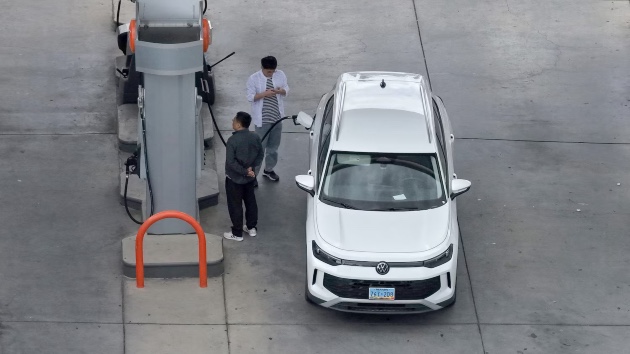
(NEW YORK) — Sky-high gasoline prices are hammering drivers across the United States as the Iran war chokes off global oil supply. California, however, may be feeling the sting more than anywhere else.
The average price of a gallon of gasoline in California clocks in at $6.13, standing 36% higher than the national average, AAA data showed. Some elected officials in the state have warned of a potential oil and gas shortage that could push prices up even further.
Siva Gunda, the vice chairman of the California Energy Commission, on Tuesday said at a hearing of the state assembly that California retains enough gasoline to satiate demand over the coming weeks.
“I do not see presently — at least up to six weeks — a supply shortfall,” Gunda said. “Beyond that, based on what we’re hearing from the industry and what we’ve observed, the pricing will move molecules to California, but it will come at a price.”
David Alvarez, a Democratic California state assembly member who represents Southern San Diego, warned of the potential impact on consumers.
“For six weeks, at least, there seems to be some certainty. But almost as certain is if this situation continues after six weeks, we would likely see some price increases,” Alvarez said.
Fuel prices in California typically run higher than other states, even in the best of times. That usual price disparity stems from regulations and taxes imposed in the Golden State, among other factors.
The Iran war has exacerbated the price pressure, exposing California’s dependence in large part on foreign imports, some analysts said. A shutdown of some key oil refineries in recent months worsened California’s vulnerability, slashing the state’s gasoline output in the absence of alternative fuel sources.
Still, the drop-off in gas supply is unlikely to produce a shortage of product at local gas stations, since an ongoing surge in prices should deter some buyers, analysts said. Under such a scenario, known as “demand destruction,” high prices make gas unaffordable for some drivers, forcing them to forgo gasoline use altogether.
“A shortage within the continental U.S. would take a really extreme situation, since prices respond to supply and demand,” Susan Bell, a senior vice president at the consulting firm Rystad Energy, told ABC News.
The Middle East conflict, which began on Feb. 28, prompted Iran’s effective closure of the Strait of Hormuz, a critical waterway that facilitates the transport of about one-fifth of the worldwide supply of oil. As a result, global oil prices have soared more than 50%.
The vast majority of oil that passes through the strait is bound for Asian markets, but some of it reaches the United States, including California. That dependence has worsened a widely felt problem: since oil prices are set on a global market, prices have climbed for just about everyone as buyers chase fewer barrels of crude.
California imports about three-quarters of its oil from foreign nations and Alaska, California Energy Commission (CEC) data shows. Roughly 30% of the state’s oil comes from the Middle East, especially Iraq and Saudi Arabia, according to the agency.
“California is challenged buying crude oil because they did buy from the Middle East,” Bell said.
The oil bottleneck has driven up the price of crude, straining the state’s supply chain. But the shortfall of gasoline in the state owes primarily to a decline in the availability of refined products, some analysts said.
California ships in a portion of its auto fuel from Asia, but those imports have been disrupted by the war, they added.
The shutdown of two major oil refineries in recent months has diminished the state’s ability to make up for the lost gasoline with in-state production, they added. A longstanding absence of adequate pipeline infrastructure connected to other states, meanwhile, has prevented California from turning to domestic supply.
Gasoline inventory in the state averaged 9.55 million barrels over the four weeks ending on April 24, CEC data shows. That figure puts inventories near the lowest level on record dating back to 2005, according to a Reuters analysis. That total stock includes non-California gasoline, blending components and California’s gasoline blend.
“California has designed an energy island in terms of the products we actually use. We’re not connected to the rest of the U.S. as efficiently as many other states are,” Paasha Mahdavi, a professor of energy governance and political economy at the University of California, Santa Barbara, told ABC News.
As a result, Mahdavi added: “There’s a crunch hitting gas stations.”
Despite the supply squeeze, California is unlikely to suffer from long lines at gasoline stations or customers leaving with empty tanks, some analysts said.
Rather, the price of gasoline will continue to move up, reaching such heights that some buyers will turn to alternatives or simply go without fuel, Severin Borenstein, a professor of Business Administration and Public Policy at the University of California, Berkeley, told ABC News.
If public officials were to put a price cap on gasoline, then customers would likely flock to the pump and empty inventories, Borenstein added. As prices surge, however, customers will fall out of the market instead.
“We don’t have any gas lines because we don’t regulate the price of gas,” Borsenstein told ABC News. “As much as people hate high gas prices, they hate gas lines even more.”
Copyright © 2026, ABC Audio. All rights reserved.
