

(NEW YORK) — Traumatic brain injuries are quickly emerging as the signature wound of the U.S. war with Iran so far, echoing a pattern of post-9/11 wars, according to a U.S. official.
More than 200 U.S. troops have so far been wounded in the war, and at least 140 of those were TBI-related injuries, the U.S. official said. It’s a surge being driven by Iran’s reliance on one-way attack drones and the concussive blasts they deliver in strikes against American troops in countries across the Middle East, including Kuwait and Saudi Arabia and Bahrain.
Symptoms of TBI can be subtle at first but often linger for years, or even a lifetime, ranging from persistent headaches, fatigue, dizziness and vertigo, to more severe cognitive effects like memory loss, impaired decision-making and difficulty concentrating.
Veterans with TBIs are also nearly twice as likely to die by suicide compared to veterans without a diagnosed brain injury, according to data from the Department of Veterans Affairs.
“If they’re near a blast, there should be no doubt they have a TBI,” Dr. Jayna Moceri-Brooks, who studies combat-related brain injuries, said. “You can’t escape from blast overpressure … symptoms can be debilitating.”
ABC News reached out to the Pentagon for comment.
TBIs have been widely seen as a signature wound of the post-9/11 wars, as insurgent tactics have relied on explosives to target U.S. troops. More than 460,000 service members were diagnosed with traumatic brain injuries between 2001 and 2023, according to VA data.
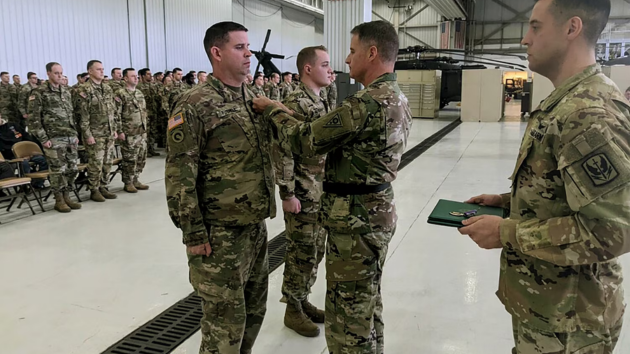
While such injuries have been suffered in warfare for generations, it wasn’t until 2011, nearly a decade into the wars in Iraq and Afghanistan, that the Army formally made TBIs eligible for the Purple Heart.
After Iran launched 15 ballistic missiles at U.S. forces at Al Asad Air Base in Iraq in January 2020, in retaliation for the U.S. drone strike that killed Iranian Maj. Gen. Qassem Soleimani, the first Trump administration initially said no troops had been injured.
That assessment was slowly revised by the administration, first minimizing the scope of the damage before ultimately acknowledging that 110 service members had been wounded, most suffering traumatic brain injuries, the kind of blast-related wounds that can carry lasting, life-altering effects.
In the years since the attack, Staff Sgt. Aaron Futrell, 44, who served in the Ohio Army National Guard, who was near one of the missile strikes at Al Asad, has wrestled with a cascade of lingering symptoms. What were once daily, debilitating migraines have only recently subsided to once or twice a week with treatment through the VA. He still deals with memory lapses, describing his cognition at times as “buffering like a YouTube video,” struggling mid-sentence to find the right words.
The first year after his injury proved especially grueling. Futrell said he was often overcome by extreme fatigue, going straight to bed after work and feeling as though he “lost a year” of his life. He was medically discharged from the Guard, where he served in aviation operations, and was given a high disability compensation rating from the VA.
Even routine settings can present challenges. Loud, echoing environments, like his son’s school, can trigger headaches, at times forcing him to sit out events from his car.
“I limit myself to some places,” Futrell said. “It’s learning what places might trigger headaches or be stress-inducing.”
The toll extends beyond his own health. “It has been a huge strain on my family and me,” he said. “I don’t look disabled. I can act like a normal individual. I’m good until I’m not.”
Copyright © 2026, ABC Audio. All rights reserved.
