

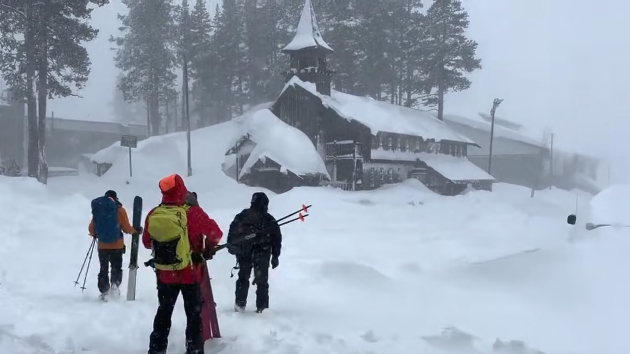
(NEVADA COUNTY, Calif.) — Eight backcountry skiers have been found dead, and one remains missing following an avalanche in California’s Sierra Nevada Mountains, officials announced Wednesday.
Search crews on Tuesday braved “highly dangerous” conditions to rescue six other skiers who were part of the same guided group, authorities said.
The tragedy is the deadliest U.S. avalanche in 45 years, second only to an avalanche that killed 11 people on Washington’s Mt. Rainer in 1981.
Crews were working on Wednesday to bring the remains of the eight dead skiers — seven women and one men — off the mountain as soon as possible to be reunited with their families after autopsies are performed to determine the cause of death, authorities said.
Nevada County Sheriff Shannon Moon announced the deaths at a news conference on Wednesday and said the skier who remains missing is presumed to be deceased.
Moon said that among the dead were three guides from the company Black Mountain Guides. The ages of the deceased ranged from 30 to 55, Moon said.
Perilous conditions near Donner Pass, where the avalanche occurred, continued on Wednesday morning. Rescuers faced a winter storm dumping more than 2 inches of snow an hour in the area, grounding rescue helicopters and hampering ground crews trying to reach the missing skiers, according to the Sierra Avalanche Center.
Tuesday’s avalanche was reported around 11:30 a.m. PT in the Castle Peak area at an elevation of 8,200 feet in the Sierra Nevada northwest of Lake Tahoe, according to the Nevada County Sheriff’s Office.
A group of 15 skiers, including four guides from Blackbird Mountain Guides, encountered the avalanche, according to the sheriff’s office.
“The group was in the process of returning to the trailhead at the conclusion of a three-day trip when the incident occurred,” Blackbird Mountain Guides said in a statement.
Based on the accounts of the survivors, Capt. Rusty Greene of the Nevada County Sheriff’s Department said all 15 members of the group were together when the avalanche occurred.
“It was reported by the individuals that survived that they were attempting to go out as a group, that someone saw the avalanche, yelled ‘avalanche’ — and then it overtook them rather quickly,” Greene said.
Greene said the bodies of the eight skiers were located near where the survivors were found. He said survivors of the incident had located three of the bodies before the rescue teams arrived.
Preliminarily, the slide measured a D2.5 on the Destructive Force Scale, the avalanche version of the Enhanced Fujita Scale for rating tornadoes, meaning it was strong enough to injure, bury, or kill a person, according to the Sierra Avalanche Center. A D3 on the scale is strong enough to destroy a house.
Six people — five women and one male guide — were successfully rescued Tuesday evening by search-and-rescue teams with varying injuries, Moon said. The survivors had been taking cover under a tarp when they were found alive, according to Moon.
Moon said the deceased skiers were from several different states and that their relatives were notified on Wednesday morning before the news conference.
Greene said the bodies were placed in a location where they will be easy to recover once the weather allows.
The survivors made a 911 call using an iPhone satellite SOS message, the sheriff’s officer said. Emergency beacons also helped rescuers find the stranded skiers, the sheriff’s office said.
“Due to extreme weather conditions, it took several hours for rescue personnel to safely reach the skiers and transport them to safety where they were medically evaluated by Truckee Fire,” the Nevada County Sheriff’s Office said in a statement. “Two of the six skiers have been transported to a hospital for treatment.”
Moon said initially, authorities were told that 16 skiers were in the group, and 10 were missing. She said it was later learned that one person decided not to make the trip at the last minute.
Rescuers faced very difficult conditions, including avalanche danger themselves, according to Brandon Schwartz, director of the Sierra Avalanche Center, which forecasts avalanche conditions in the area around Lake Tahoe. The area saw 2 to 3 feet of new snow in the last 36 hours and more was still falling at 2 to 4 inches per hour, Schwartz told ABC News.
Moon said two search teams comprising nearly 50 rescuers approached the avalanche site from the north and the south. Snowcats transported the teams to within two miles of the avalanche site, and from there, the rescuers had to ski to the location, arriving around 5:30 p.m. on Tuesday.
Moon said two of the survivors suffered injuries that prevented them from walking. The survivors were taken back to the snowcats and driven back down the mountain, Moon said.
Two of the survivors were initially hospitalized, but Moon said one remained in a hospital on Wednesday.
The Blackbird Mountain Guides said the avalanche happened near the Frog Lake Backcountry Huts in the Castle Peak area, northwest of Truckee.
The group of skiers had been staying at the huts — which the company describes in online advertisements as “luxury-dormitories” — since Sunday. A 3-to-4-day stay at the huts normally costs $1,795, according to the company’s website.
The company lists prerequisites for customers, including requiring skiers to be “adept with their backcountry touring skills and have a solid foundation of touring before the trip.” Customers are also required to be in good physical shape, according to the company, “able to hike 4-6 miles and climb 1,500-2,500 vertical feet throughout the course of a day.”
The Sierra Avalanche Center said there was “high” avalanche danger in the backcountry on Tuesday, raising questions of why the group was in the rugged area.
On Monday, Blackbird Mountain Guides posted a video on Instagram showing what it described as “atypical layering from our normal mid season snowpack.”
“The result is a particularly weak layer in many northerly aspects, across various elevation bands,” a company employee said in the video. “As we move into a large storm cycle this week, pay close attention to places where faceting has been particularly strong — avalanches could behave abnormally and hazards could last longer than normal.”
Asked by reporters why the group was in the area despite the dangerous avalanche conditions existing, Moon said, “Those are the decisions the guide company clearly had made.”
“We’re still in conversation with them on the decision factors that they made. But, definitely, a heed for everyone,” Moon said.
The Sierra Avalanche Center said rapidly accumulating snowfall, weak layers of existing snowpack and gale-force winds that blow and drift snow “have created dangerous avalanche conditions in the mountains.”
“Natural avalanches are likely, and human-triggered avalanches large enough to bury or injure people are very likely,” the center said.
The center has issued an avalanche warning for the Central Sierra Nevada Mountains between Yuba Pass on the north and Ebbetts Pass on the south, including the greater Lake Tahoe area, through Wednesday morning.
In an updated statement on Wednesday morning, the center said, “HIGH avalanche danger continues,” and added, “travel in, near, or below avalanche terrain not recommended.”
“Increased uncertainty exists with ongoing reactivity of these buried weak layers under this large storm snow load. The potential continues for large to very large avalanches occurring in the backcountry today.”
Whiteout conditions have been reported in the region where the avalanche occurred.
The California Highway Patrol’s Truckee office warned that high winds are “creating full whiteout conditions” across the Donner Summit.
Interstate 80 over Donner Summit was closed in both directions on Tuesday and remained closed on Wednesday morning due to whiteout conditions and poor visibility.
Copyright © 2026, ABC Audio. All rights reserved.
